

We bring this series to a close with the most controversial of the five species: the brown bear. Not because it is dangerous – it is, in fact, one of the large European mammals with which it is easiest to coexist – but because it is large, because it is a predator, and because its absence from Portugal seems, at first glance, to be permanent. It is not.
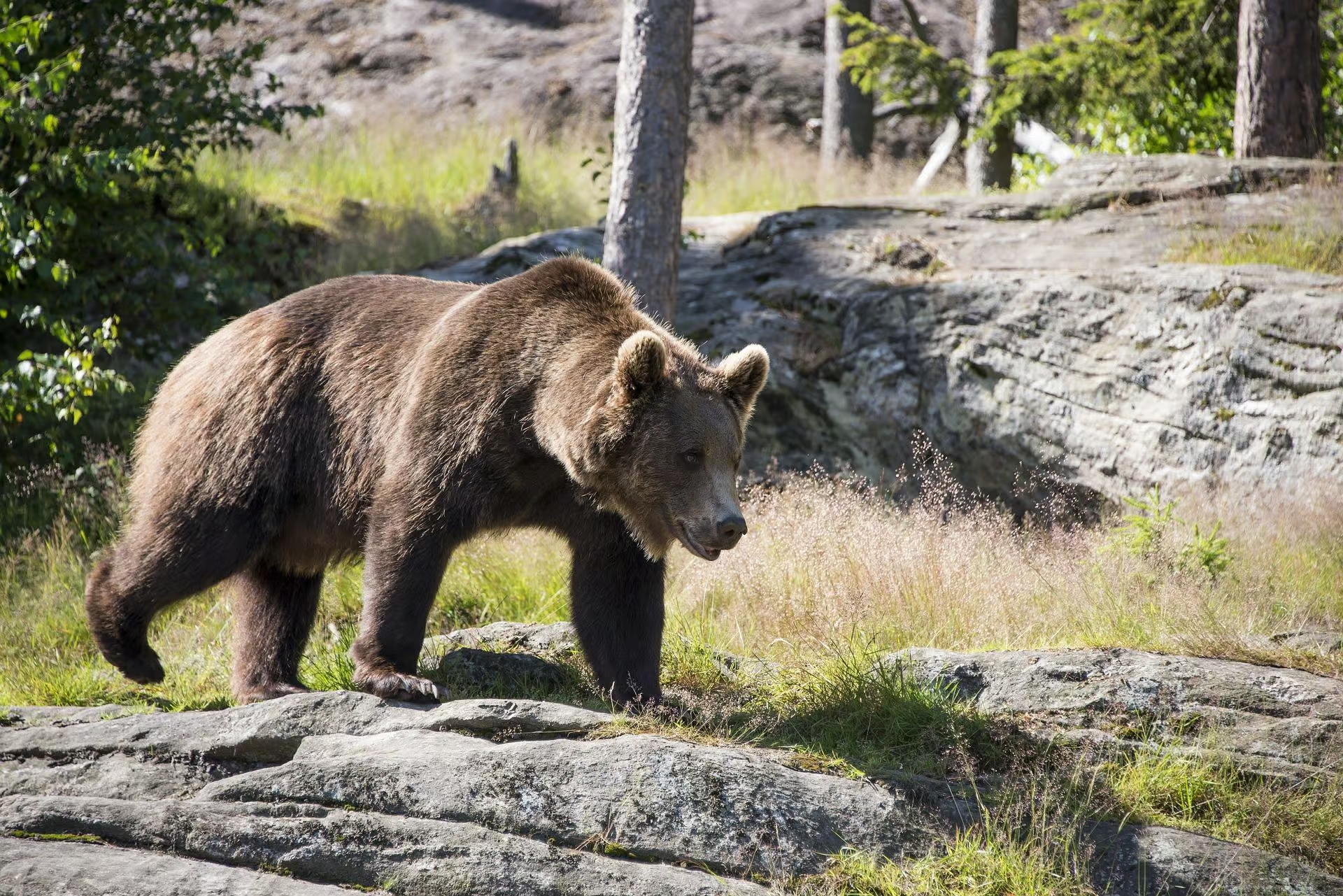
Much more than a predator
The popular image of the bear is that of a hunter. And it is — but above all, it is an omnivore that operates at multiple levels of the ecosystem simultaneously. In spring and summer, between 70 and 80 per cent of its diet may consist of plant matter: berries, fruits, roots and insects. It is one of Europe’s greatest seed dispersers, capable of travelling dozens of kilometres a day and depositing seeds far from the parent plant, often accompanied by natural fertiliser. The regeneration of mountain forests is closely linked to its presence.
It is also a soil engineer: its digging in search of tubers and larvae aerates and disturbs the soil, promoting plant diversity. The carcasses it leaves behind — or which it scavenges as an opportunistic scavenger — provide food for dozens of other species. And, as a predator, it regulates the behaviour of prey and other carnivores, even without being the most efficient hunter (that title belongs to the wolf).
In Portugal, the bear was present until the 19th century, with historical records in the Serra da Estrela, Peneda-Gerês and the north-east of Trás-os-Montes. According to research by Paulo Caetano and Miguel Brandão Pimenta (authors of the book *The Brown Bear in Portugal — Chronicle of an Extinction*, 2017), the last bear killed on Portuguese soil was shot in Gerês in 1843. It did not disappear due to a lack of habitat: it was driven to extinction by direct persecution — hunting, traps and poison.
The example of the Pyrenees
To understand what is possible, it is worth looking at a case of formal reintroduction in a geographically close location: the Pyrenees.
Throughout the 20th century, hunting and poisoning drove the Pyrenean population to the brink of extinction. By the mid-1990s, only five individuals remained, and the population was biologically unsustainable. The western subpopulation, in the French Béarn region, was even more depleted — with just two or three native individuals remaining. On 1 November 2004, the last female of pure Pyrenean lineage, Cannelle, was shot by a hunter during a wild boar drive in Urdos, in the Vallée d’Aspe. Her cub, aged around eight months, survived. The incident caused consternation across Europe, and the then French President, Jacques Chirac, described it as a major loss for French and European biodiversity.
Even before this symbolic loss, in 1996, the French government and the ADET-Pays de l’Ours association had launched the first formal reintroduction programme in the central Pyrenees. That year, two pregnant females from Slovenia were released, followed by a male in 1997. In the following years, a further eight bears were introduced, two of them in the western region — where the last native bears had lived. In total, eleven individuals, all of Slovenian origin. Cannelle’s death in 2004 would go on to accelerate a second wave of reintroductions in 2006.
The recovery has been steady ever since. The official report by Réseau Ours Brun, coordinated by the Office Français de la Biodiversité (OFB) and published in March 2026, recorded a minimum of 108 bears in the Pyrenees in 2025. A statistical capture-mark-recapture model estimates the actual population to be between 109 and 143 individuals, with a mean of 130 — representing an average annual growth rate of 11.53 per cent since 2006. The range currently covers around 7,000 km², spread across France, Spain and Andorra.
A study by Sanz-Pérez and colleagues, which analysed the spatial structure of the Pyrenean population by sex and age between 2017 and 2021, helps to explain the pace of this expansion: the dispersal front is dominated by young and subadult males, whilst females and juveniles remain concentrated in the central core. This asymmetry — resulting from the philopatry of females, who tend not to stray far from their birthplace — is the main constraint on geographical expansion and the strongest scientific argument in favour of further translocations of females to peripheral areas with suitable habitat.
Coexistence: difficult, but manageable
Bears attack beehives and sheep on high-altitude pastures, and there is real tension with pastoral communities, particularly in France. However, experience gained over three decades shows that coexistence is technically feasible when investment is made in the right protection systems. The LIFE PirosLife project, implemented in Catalonia between 2014 and 2019, demonstrated that herds protected by electric fences, shepherds and guard dogs were several times less likely to be attacked than unprotected herds. There are ‘expert’ bears that learn to bypass simple fences, requiring reinforced barriers — but they are the exception, not the rule, and there are technical solutions whose costs pay for themselves within a few years. A financial compensation scheme for losses attributable to bears, combined with community engagement programmes, has been key to ensuring that opposition, whilst still present, does not hinder the recovery of the population.
And Portugal?
The idea of reintroducing bears to northern Portugal may seem ambitious — but it is based on concrete ecological facts and deserves to be considered as a long-term objective within the framework of the National Nature Restoration Plan.
The western subpopulation of the Cantabrian Mountains — estimated at several hundred individuals, centred on Asturias and León — is the closest to Portugal, with a range that already extends into Galicia, directly on the border with the north of the country. The mountain ranges of north-western Portugal, such as Gerês and Montesinho, share the same floristic composition and the same humid Atlantic climate that characterises the habitat currently occupied by Cantabrian bears: oak, beech and birch forests; gorse and heather scrub; high-altitude pastures; and rivers teeming with salmon and trout.
A study published in 2025 in the journal *Scientific Reports*, based on surveys of Portuguese and Spanish populations, found generally positive attitudes towards bears in Portuguese regions with the potential to host them — and even more favourable attitudes in Spanish communities with a long history of coexistence with the animal, suggesting that familiarity alleviates fear rather than increasing it.
And there is one specific incident that makes this possibility seem less abstract. In late April 2019, a brown bear crossed the border from the Sanabria region (Castile and León) and was spotted in the Montesinho Natural Park, in Bragança — the first confirmed sighting in Portugal since 1843. The ICNF, in coordination with the Spanish authorities, monitored the animal using camera traps, tracks and samples collected. Along the way, the bear consumed more than 50 kilograms of honey from a local beekeeper, Luís Correia, who told the press that the animal was welcome and that he would like its presence to become a regular occurrence. The animal was not detected again — it was probably a young male dispersing, exactly the pattern described in studies: it is young males who arrive first in peripheral areas.
This episode does not prove that a population will become established in Portugal tomorrow. But it demonstrates two things: that the distance between the Cantabrian populations and the north of the country is no longer insurmountable for dispersing animals, and that, when the bear arrived, those on the ground reacted with curiosity, not hostility.
What can be done now
This is not about proposing the release of bears in Portugal tomorrow. It is about advocating that the National Nature Restoration Plan identifies the northern mountain ranges as areas of future potential for the species, and that action be taken immediately on three fronts: a rigorous scientific assessment of the carrying capacity of these mountain ranges; a process of dialogue with the region’s rural communities, drawing on models of coexistence tested across Europe; and technical and diplomatic discussions with the Spanish authorities regarding the prospects for connectivity and the natural expansion of the Cantabrian population towards Portugal.
Natural expansion cannot be ruled out from the outset. The western subpopulation of the Cantabrian bears has already reached Galicia — just a few dozen kilometres from the Serra do Gerês. If the habitat is maintained and human pressure managed, the border may simply cease to be an obstacle.
The bear is not an easy species: it requires space, it requires active coexistence, and it requires the ability to manage conflicts. But the Pyrenees show that formal reintroduction can work even in a landscape shaped by human activity — and that the decisive factors for success are not technical, but political: the will to move forward, fair compensation schemes, and the genuine involvement of local communities. And Asturias shows that sustained coexistence can transform the bear into an economic and cultural asset. Because where there are bears, there is nature tourism. And where there is nature tourism, there are reasons to stay in a region that would otherwise continue to lose its population.