

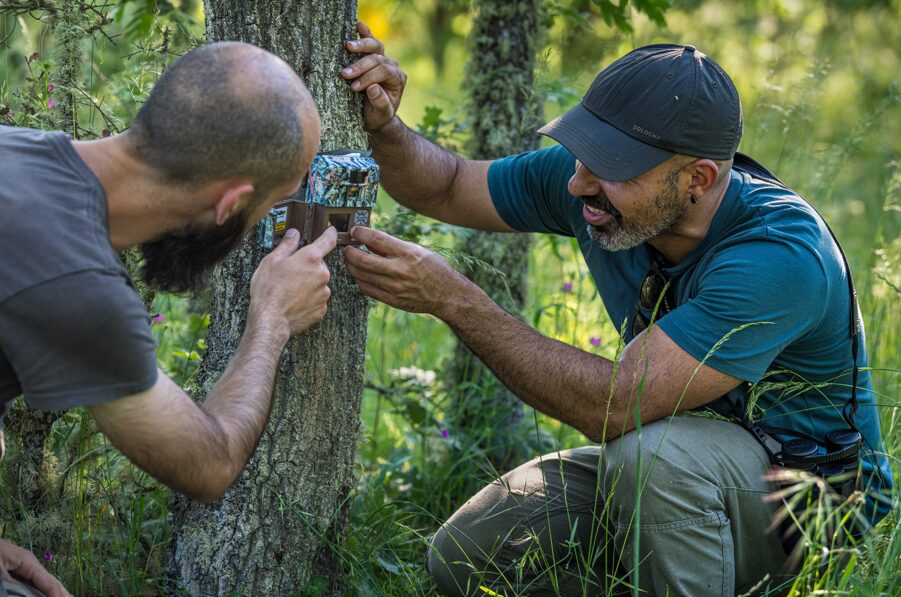
The two Rewilding Officers from Rewilding Portugal, who are involved in beaver monitoring and were responsible for last year’s discovery, tell us first-hand what this process was like and what the next steps are for continuing to monitor this progress in the near future.
How and when was the first reliable sign of a beaver’s presence on Portuguese territory detected, and what was the exact moment when you realised that ‘it really is a beaver’ and not another species present there?
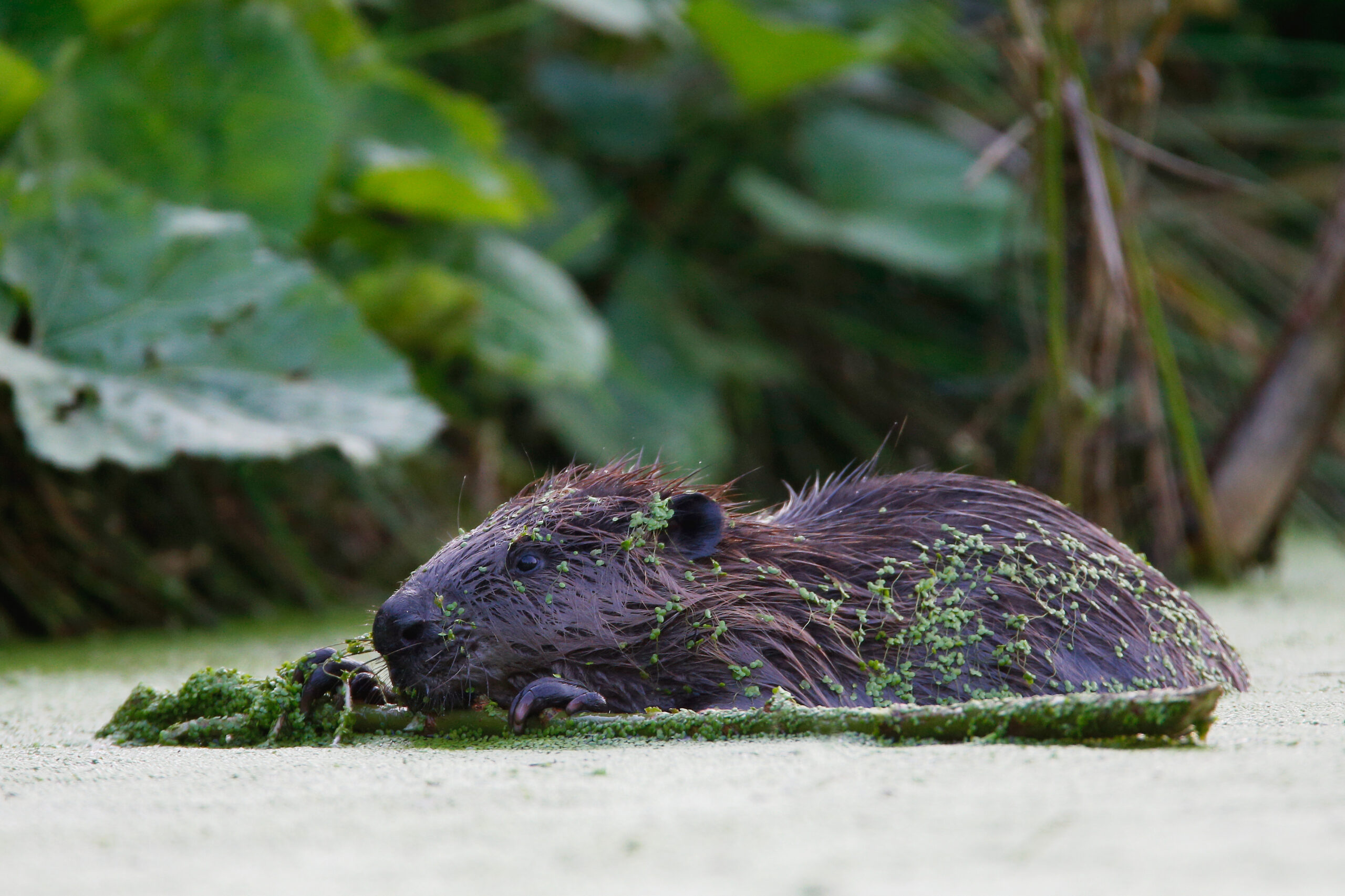
When we spotted a small fallen tree with extensive gnawing marks and a large amount of wood shavings piled up in the same spot on the ground. No other species does that. It was in March 2025, but the water level in the River Douro was very high and conditions were unsuitable for setting up camera traps. We returned in May and saw that not only were there still fresh signs in the same spot, but we also discovered other gnawed trees along the river. We set up several cameras and, after a few days, we immediately had the first photos and videos of the beaver, thanks to two cameras that had been flooded by the rising river level.
What monitoring methods have been used over recent years to track the beaver’s advance towards the border?
We surveyed 500-metre transects along the lower reaches of the River Tormes, where the Spanish population was centred, and the banks of the River Douro, approximately twice a year. Both banks of these watercourses were surveyed for signs of their presence, particularly gnaw marks on trees. Using this method, we were able to track the beavers’ natural expansion along the River Tormes until we decided to focus more of our monitoring efforts on the River Douro; with each visit to the Tormes, we found evidence of their presence getting ever closer to Portugal. Camera traps were deployed on the Portuguese side after we observed the first signs of their presence.
What sort of data are you still collecting at the moment, and what do you hope to learn from continuing this monitoring?
We will continue to monitor the area using the same methods, focusing solely on the River Douro. Now that we know the species is present there, the cameras will be even more important in helping us to understand whether there are several individuals and whether they are established in the area. We are curious to see how they will behave in this stretch of the river, which offers less favourable conditions than the River Tormes. We are very keen to document the species’ expansion within Portugal. In the future, we will probably extend our monitoring to the area where the River Ulces flows into the Douro, as signs of beavers have also recently been found in that river.
Is it likely that the beaver population in that area will continue to grow, or was this merely a sporadic visit?
We do not yet know whether the animal we recorded was there temporarily, or whether there is in fact already an established territory. However, it seems extremely likely to us that the species will continue to expand into the Douro, despite the existence of potential barriers (large dams) that may slow its dispersal, and the fact that in many places the habitat is not ideal, with very rocky banks and few trees. Ultimately, however, the young beavers from the ‘Spanish’ families will have to find their own territory and spread throughout the Douro.
What does this discovery mean, personally, to each of you?
André: For me, it was a moment of great joy – it’s not every day that you document the return of a species after several centuries of extinction in Portugal! It was the result of a consistent and challenging effort in the field that eventually bore fruit. But what makes me happiest is having this very important species back.
Pedro: It was one of the most memorable moments of my life as a biologist; making the first record of a keystone species that had been extinct in Portugal for centuries isn’t something we even dream of doing whilst we’re studying at university. The return of this species is a sign of hope for our ecosystems, which are increasingly under threat from human activity, and being at the forefront of witnessing the return of extinct species as important as the beaver is extremely rewarding and inspires me to continue working for nature conservation.