

There is a bird that no longer flies over the Portuguese mountains – and which, of all the species that have disappeared, is perhaps the most telling example of what it means to lose a scavenger: the Bearded Vulture.
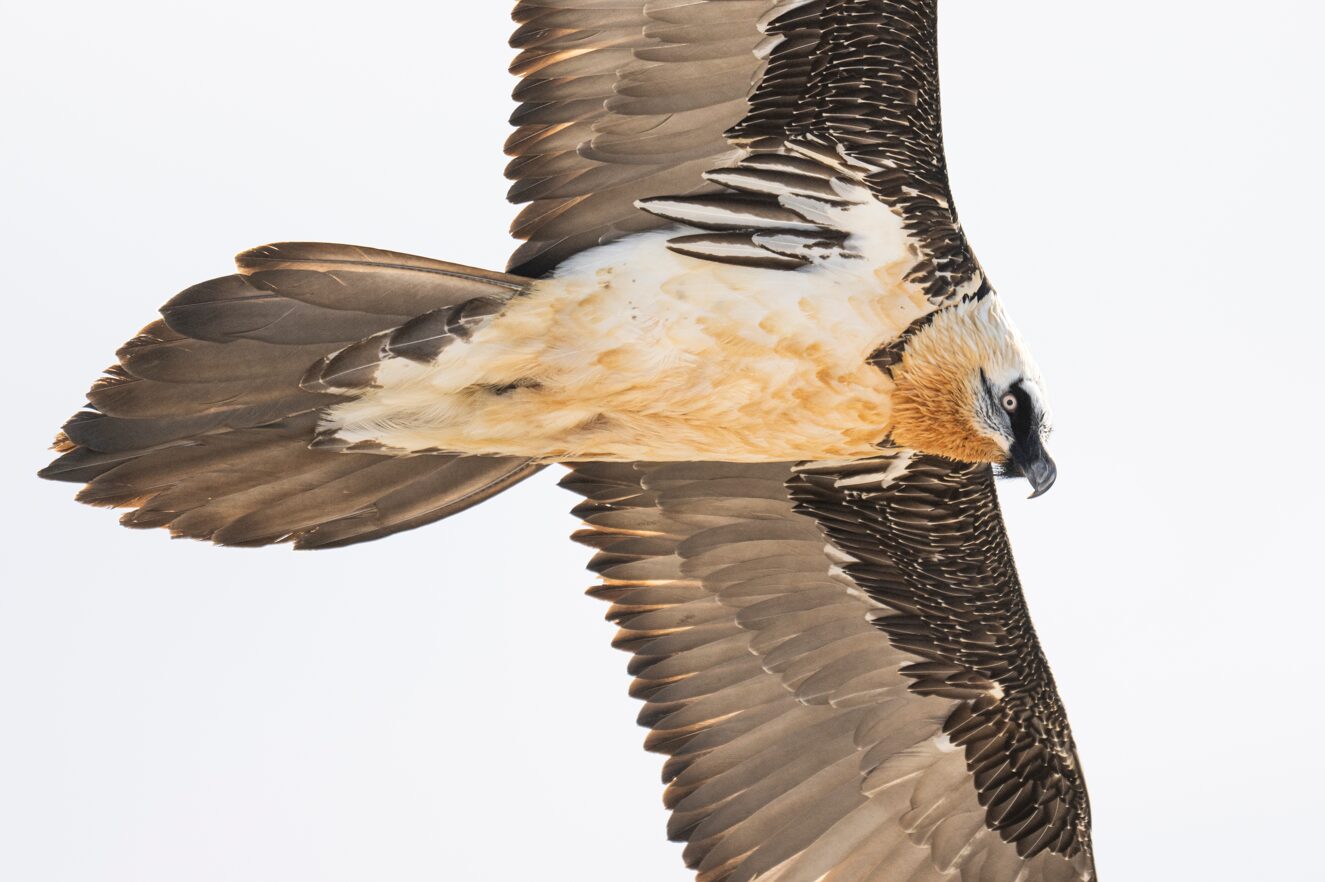
The bearded vulture (Gypaetus barbatus) is unique amongst European birds: over 70 per cent of its diet consists of bones. To this end, it has developed adaptations that no other bird possesses — a stomach with a pH so acidic that it dissolves bone in less than 24 hours, and a behaviour known as ‘ossifragia’, in which the bird soars to great heights with a bone in its talons and drops it onto rock to break it into fragments that it can swallow. It also rubs its breast against sediments rich in iron oxide, acquiring the rust-coloured hue that earned it, in Portugal, the name given to it by King Carlos: ‘bearded eagle’.
It is the final-stage scavenger. Where griffon vultures and black vultures leave a carcass after consuming the soft tissues, the bearded vulture arrives next and recycles what remains — the bones. This recycling returns calcium and phosphorus to the landscape and reduces the persistence of bones in the ground, a factor associated with the transmission of diseases amongst herbivores. It is an ecological role that no other species can fulfil.
Mainland Portugal lost this species during the 20th century, as a result of direct persecution, poisoning by bait intended for predators, and the collapse of the wild ungulate populations on which it depended. It is now classified as regionally extinct on the Red List of Birds of Portugal.
An example that already worked out
The most relevant case for considering Portugal’s future is not the Pyrenees, where the species never completely disappeared, but the Alps — where it became extinct in the early 20th century and was reintroduced from 1986 onwards, using birds bred in captivity. The first breeding in the wild took place in 1997, eleven years later. Today there are 77 territorial pairs in the Alps, with 49 fledglings recorded in the last breeding season. It is one of the greatest successes in bird reintroduction ever achieved in Europe.
Even more significantly: once the Alpine population had become established, the birds began to disperse on their own into new territories — the French Massif Central, the Cévennes, and areas of the Pyrenees outside their historical range. The Iberian population, centred on the Pyrenees, grew from 59 territories before 1995 to 198 in 2023.
In April 2026, the University of Málaga and the Fundación para la Conservación del Quebrantahuesos published the first Iberian-scale ecological connectivity model for the species, combining GPS data from 57 individuals with environmental suitability models. Portugal is not included. This is not an arbitrary decision, but because there is no Portuguese field data to justify its inclusion — no monitoring of individuals, no habitat suitability studies. It is as much a symptom as it is an omission.
The study also confirms a crucial point: the species’ extreme philopatry means that spontaneous recolonisation from the Pyrenees would be a process taking decades. There have been records of incursions by juveniles into Portugal since 2008, but without deliberate intervention to create conditions that attract and encourage them to settle, these incursions will remain isolated incidents, not the start of a population.
Plans on paper
Portugal is not without tools. The Strategy for the Conservation of the Bearded Vulture in Spain and Portugal, approved in February 2025 and co-signed by the ICNF, formally recognises that Portugal has no recovery plan for the species and that it is not even included in the current Action Plan for the Conservation of Scavenger Birds (PACAN) — stipulating that this document must be revised to include it.
The European LIFE project ‘Iberian Corridors for the Bearded Vulture’, approved in 2022 and running until 2027, outlines an east-west ecological corridor across the Iberian Peninsula, with the ICNF involved as a guest observer. However, as far as can be ascertained, the ecological studies planned for northern Portugal have not been carried out, there are no findings on the potential of the International Douro region, and the PACAN has yet to be revised, despite the commitment made.
This pattern is not unique to the bonecrusher. Since 2020, Rewilding Portugal has submitted licence applications for the disposal of carcasses in the field in the Greater Côa Valley — a measure provided for by PACAN itself. It waited five years for the first approval, granted in January 2025. The remaining applications have yet to receive a response from the ICNF.
What is still to be done
None of this makes reintroduction impossible — it simply makes it more of a long-term prospect than it needs to be. In the immediate term, between 2025 and 2027, it would be necessary to carry out the habitat suitability studies already planned for the Douro Internacional and the Serra da Malcata, to establish a formal system for monitoring individuals entering Portuguese territory, and to revise the PACAN to include the species.
In the medium term, Portugal needs its own population feasibility analysis, which answers three questions: which areas have sufficient ecological conditions, which threats must be eliminated first, and what scale of intervention would be required. Such an analysis already exists for Gredos, the Maestrazgo and the Picos de Europa. It does not exist for any Portuguese area.
The 2025 Iberian Strategy has an eight-year timeframe and targets for 2030. Portugal is formally included. Transforming this nominal presence into a real one requires the ICNF to move from being an observer to an active partner, for PACAN to be revised, and for dedicated funding to be provided. The policy framework already exists — what is lacking is implementation.
A programme that drags on indefinitely without resolution would not merely be a failure of conservation. It would be an institutional failure, with consequences for Portugal’s credibility as a partner in European nature restoration programmes.