
Official position of Rewilding Portugal on the SOPHIA Project (Fundão–Penamacor Solar Power Plant) and associated LMATs
Rewilding Portugal expresses its firm and well-founded opposition to the SOPHIA Solar Photovoltaic Power Plant (CSF Sophia) project and the associated Very High Voltage Lines (LMAT), currently under public consultation. This position is based on a detailed analysis of the official data from the Environmental Impact Assessment (EIA) and an assessment of the ecological, social and territorial risks that the project poses to central Portugal, in particular to the municipalities of Fundão, Penamacor and Idanha-a-Nova, with significant and irreversible impacts on local ecosystems, the landscape, the communities in this region and the sustainable development model for the territory that we advocate.
Although we recognise the urgency and importance of the energy transition, we consider that the project in question does not meet the minimum criteria for territorial, ecological and social sustainability. Significant and irreversible impacts have been revealed on high-value ecosystems, on the rural landscape of Gardunha and on communities that have been investing in ecological regeneration and nature tourism. The mitigation and compensation measures presented are insufficient and do not respond to the scale of the expected damage, and we do not believe that there is any possible mitigation for such destruction and artificialisation of the landscape in question. We therefore believe that the SOPHIA project does not represent a fair energy transition, but rather a model of artificialisation of the territory, incompatible with the principles of conservation, ecological restoration and territorial cohesion.
What is at stake?
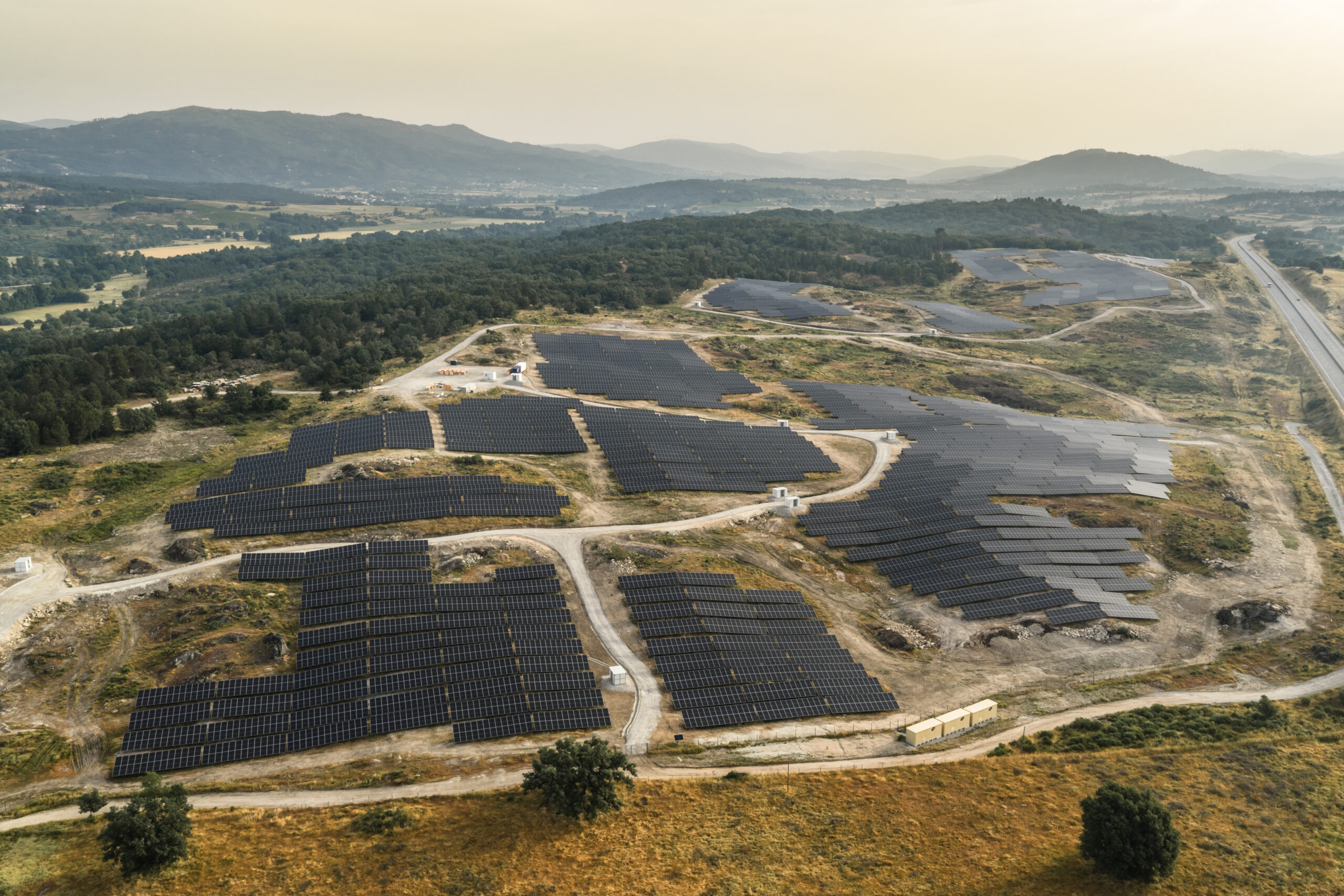
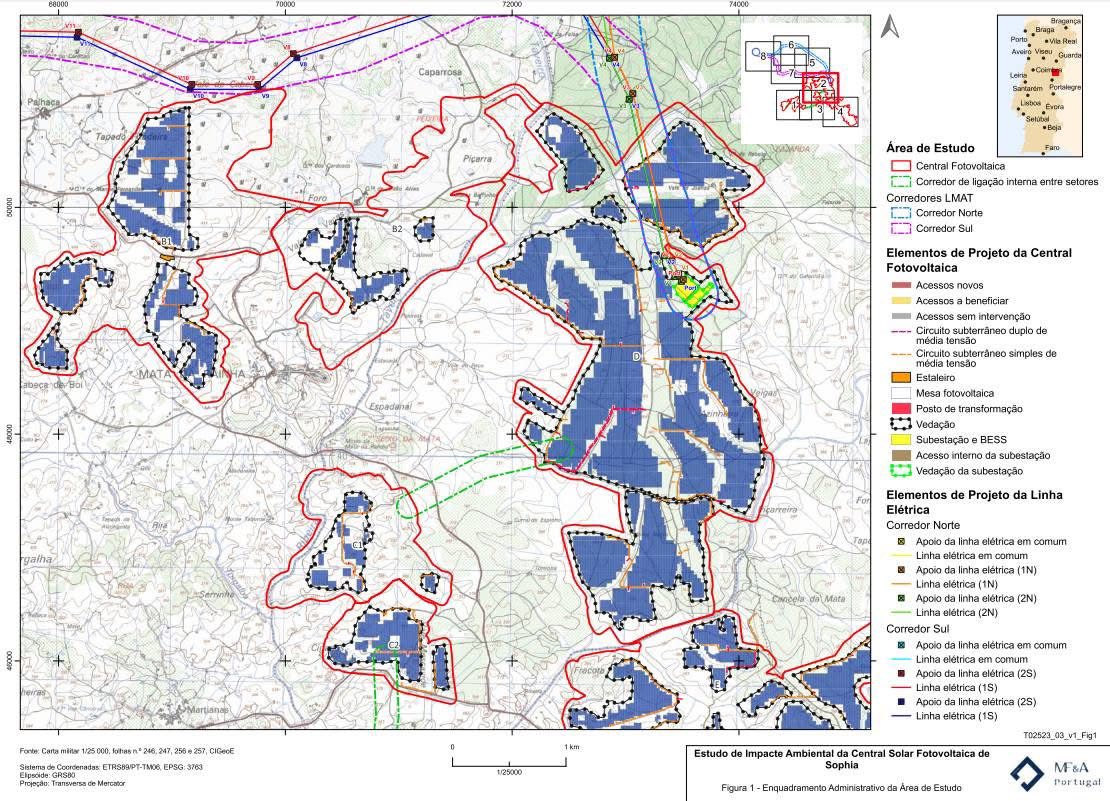
According to the EIA, this solar power plant will occupy a total area of over 3,500 hectares, of which around 434 will be directly covered by solar panels, paths and associated infrastructure. The project extends across three municipalities and includes two very high voltage lines (400 kV), each approximately 22 km long, connecting to the Fundão substation. These lines cross agricultural areas, forest stands and river valleys that still maintain significant ecological connectivity.
It is also recognised that the implementation area covers and marginally intersects classified areas, namely the Serra da Gardunha Special Conservation Area (SCA) (Natura 2000 Network) and the Serra da Gardunha Regional Protected Landscape Area. The southern boundary of the project also approaches the UNESCO Naturtejo World Geopark, which is part of a landscape of high natural and heritage value. Seven types of natural habitats of high ecological value have therefore been identified, including evergreen Quercus montados, oak groves, willow groves, ash groves and alluvial forests, ecosystems protected by national and EU legislation.
The same study records 231 species of vertebrates in the area in question, 30 of which are classified as endangered. Among the most sensitive species are the black stork (Ciconia nigra), the Cinereous vulture (Aegypius monachus), the imperial eagle (Aquila adalberti) and several species of protected bats, amphibians and reptiles. In terms of flora, the presence of Bufonia macropetala, a rare Iberian endemic species and indicator of intact Mediterranean soils, has been confirmed. These are fragile species with worrying conservation status and already reduced and fragmented habitats.
The study also confirms that the construction will involve the deforestation and felling of legally protected trees, namely isolated holm oaks and cork oaks, with an impact classified as negative and significant. The proposed compensatory measures, such as the conversion of 135 hectares of eucalyptus into holm oaks and cork oaks, totalling 228 hectares of ecological compensation, do not demonstrate net gains in biodiversity and do not eliminate the irreversible loss of local habitats. We cannot continue to replace complex, well-established habitats that influence a huge number of species with established populations with new plantations that will take a long time to reach that state of functionality. The technical analysis also confirms the interruption of the ecological corridors designated ‘Raia Norte’ and ‘Raia Sul’ (PROF Centro Interior), fragmenting areas critical for the movement and reproduction of wildlife. At a time when we are talking about the urgent need to create and strengthen ecological corridors that allow wildlife to move across the landscape, cutting one of these corridors in half is inconsistent, dangerous and unjustifiable.
Our position against this project is therefore based on three pillars: biodiversity, communities, and visitation:
-
BIODIVERSITY
Nature needs space and connectivity to thrive, and the SOPHIA project blatantly ignores this principle by installing a solar megastructure in a mosaic of habitats that functions as a regional ecological corridor, cutting off the continuity between the natural areas of Gardunha, Raia and Malcata, and thus creating a physical and ecological barrier that is difficult to reverse.
Soil fragmentation and sealing compromise the mobility of large and medium-sized mammals, such as the Iberian wolf (Canis lupus signatus), among others, and affect fragile species and Mediterranean flora adapted to poor soils, such as the rare Bufonia macropetala. The destruction of these habitats and plant communities, recognised by the EIA itself as a significant negative impact, harms pollinators, insectivorous birds and the food chain in this region.
This stance contradicts national and European commitments to protect priority habitats, which continue to be ignored in situations such as this and in which we repeatedly fail to meet targets, incurring constant fines that continue to be paid as the price of national inaction that is difficult to understand.
The so-called ‘green transition’ cannot justify the repetition of landscape fragmentation errors that conservationists and many entities in this sector have been struggling to correct for decades, with difficulties and often in a context of underfunding.
2. COMMUNITIES
Rewilding Portugal emphasises that the local communities affected by this project are being doubly penalised by their inland location: they suffer the direct impact of this facility and, despite generic promises of economic returns and impact mitigation, they are not guaranteed any tangible benefits proportional to the environmental and social costs they will bear. The absence of truly participatory processes for communities reveals a lack of transparency that cannot be accepted in projects of such scale and risk.
It is important to note that local populations will be faced with: loss of agricultural and forest areas, noise and dust during construction, irreversible alteration of the rural landscape, even from a visual point of view, devaluation of properties and limitation of traditional land uses and, above all, the loss of the biodiverse and rich landscapes that are often the reason for their continued presence in the territory. The territories of Beira Interior have a strong rural and ecological identity, today boosted by small tourism businesses, organic farming and ecological restoration initiatives with a positive impact on the landscape in which they are located. Their replacement by a mega-structure of solar panels represents a cultural and economic shock.
It is unacceptable that the energy transition should be carried out at the expense of less densely populated areas, destroying their greatest remaining asset and thus perpetuating historical inequalities and contravening the principle of environmental justice that should prevail.
3. VISITATION
Beira Interior has been establishing itself as an emerging destination for nature and conservation tourism. The Serra da Gardunha, the adjacent SAC and the Naturtejo Geopark offer a unique combination of landscape, biodiversity and cultural heritage. The visual impact of this project, with its intrusion into the landscape and reflections visible from great distances, will irreversibly affect the perception of ‘untouched nature’ that still persists in this territory and makes it so attractive.
This type of impact directly threatens nature tourism, which has grown consistently in recent years, based on a sustainable development model that has guided the recent strategy of these territories and which we have been promoting, now seeing all the work done being called into question.
Many of our partners in the Côa Selvagem Network, who have created new opportunities and local employment based on nature, in harmony with the territory and ensuring new strategies to attract visitors to this region, while also contributing to the ecological restoration of these natural spaces, will be directly or indirectly affected by this project: either because they also operate in the territory affected by the project or because, even though they are in neighbouring locations, as is the case of the Grande Vale do Côa, they will also feel the inevitable negative impacts of the project, mainly with regard to the severity with which it will affect local biodiversity and ecosystems, potentially creating a profound discontinuity in the landscape.
A development model such as the one now being presented to us destroys the landscape and biodiversity, thereby eliminating the very asset that sustains the region’s green economy: the green landscape itself.
With this said,
The lack of transparency in this process is a serious issue that should have been addressed earlier. The lack of clarity regarding the origins and intentions of the investment raises legitimate questions about its strategic and environmental framework. A just energy transition requires complete transparency: who wins, who loses, and how decisions are made.
Rejecting SOPHIA does not mean rejecting solar energy. It means demanding responsible planning, transparency and ecological justice. There are many other areas that have already been artificialised, abandoned after human use and intervention, or even the roofs of public buildings and other strips of land, which would allow the production of this same energy without destroying habitats and creating a technological monoculture. We must have the courage to make these decisions, because large-scale solar power plants, if poorly located, replace living ecosystems with dead surfaces, creating ecological deserts in a country that needs to renaturalise, reconnect and restore itself.
We therefore propose that the Government and the competent authorities promote: the mapping of artificial areas available for this type of installation; robust tax incentives for the installation of panels on public, logistics and industrial buildings; and the creation of a Nature-based Energy Transition programme, which ensures that each megawatt produced also contributes to restoring ecosystems, and is produced without jeopardising them.
In view of the facts presented and the seriousness of the impacts recognised by the EIA itself, Rewilding Portugal calls for the complete rejection of the SOPHIA project and the associated LMATs.
Believing that the future of energy must go hand in hand with the recovery of biodiversity and complete and functional ecosystems, Rewilding Portugal also argues that Portugal should lead a true ecological transition, not just an energy transition. The biodiversity and climate crisis we are witnessing requires courageous decisions that are not susceptible to external pressures and purely economic ends.
There is no possible mitigation for cutting an ecological corridor in half, creating new barriers to a nature that is already so obstructed and fragmented. If the price to pay is biodiversity itself, don’t call it green energy.
Subscribed by:
Rewilding Portugal
Membros da Rede Côa Selvagem: Planalto Dourado, Ambieduca, Cantinho Café, Villa Bee, Casa Villar Mayor, Ama-te, Chef Miguel Veiga, Casa Painova, Flor Alta, Quintinha CB, BEIR’AJA, SóPraSi, Quinta Vale do Tourão, Pé de Cabra, Mercearia da Saudade, Soraya Melro Amigurumi, inBulla, Wild River Tours